

Could one MRI scanner be unsuitable for you even if another is not? If you’re asking, “is the LINX device MRI safe,” the answer depends on the exact implant and the conditions in its current safety labelling.
It’s understandable to worry that an upcoming scan could be delayed or unavailable when implant details are hard to find. Start by identifying your device, then share the information with the imaging team and your clinician so they can assess the planned scan. Don’t assume you’re eligible or cancel a scan based on general information alone.
This guide explains what “MR Conditional” means, what implant details the MRI team may need, and where to look for them in your implant card or medical records. It also covers steps to take before a scan and questions to discuss when considering LINX for reflux. This article provides general information only. It is not medical advice, does not create a doctor-patient relationship, and is not a substitute for consultation with a qualified doctor.
Key Takeaways
- “MR Conditional” does not mean suitable for every MRI. The planned scan must meet the conditions for your specific implant.
- To determine whether is the LINX device MRI safe for you, the imaging team needs to review your implant information alongside the scanner and scan requirements.
- Before scheduling, locate your implant records and tell both the ordering clinician and imaging staff that you have a LINX device.
- A reflux specialist can discuss your LINX history and imaging needs, but MRI eligibility requires an appropriate clinical and imaging review.
Is the LINX Device MRI Safe? The Answer Depends on Your Implant
An MRI may be possible after LINX, but only if the planned scan meets the conditions for your specific implant. If you’re asking, “is the LINX device MRI safe,” remember that the device name alone does not show whether a particular scan is permitted. MRI compatibility is not blanket approval for every scanner strength or protocol.
MRI eligibility must be assessed against the exact implant’s current labelled conditions. The manufacturer’s device information sets out those conditions, which may include the scanner’s magnetic-field strength and other requirements. Before the scan proceeds, the imaging team needs to compare the planned scan with the applicable conditions, with qualified clinicians involved in reviewing your situation.
Why there is no single yes-or-no answer
LINX devices from different generations or models may have different MRI conditions. A field-strength limit for one implant may not apply to another. Tesla, abbreviated T, is the unit used to describe an MRI scanner’s magnetic-field strength. Knowing the scanner’s Tesla rating alone is not enough: the implant’s own labelling must also be considered.
For example, two people may both have a LINX implant but have different device records, so their MRI options could differ even if they are scheduled to scan at the same facility. The scan protocol matters too. Meeting a field-strength condition does not automatically mean every other requirement has been met.
This distinction matters when considering LINX as a treatment for gastroesophageal reflux disease (GERD), a condition involving reflux of stomach contents into the oesophagus. MRI compatibility is one consideration in understanding individual care, alongside the reasons for treatment and any anticipated imaging needs.
Don’t use another patient’s experience or a general online limit to decide whether you can have a scan. The appropriate review matches your implant’s current labelled conditions to the proposed MRI. Start by finding your implant information so the clinical and imaging teams can assess it.
How LINX MRI Conditions Depend on the Device and Scanner
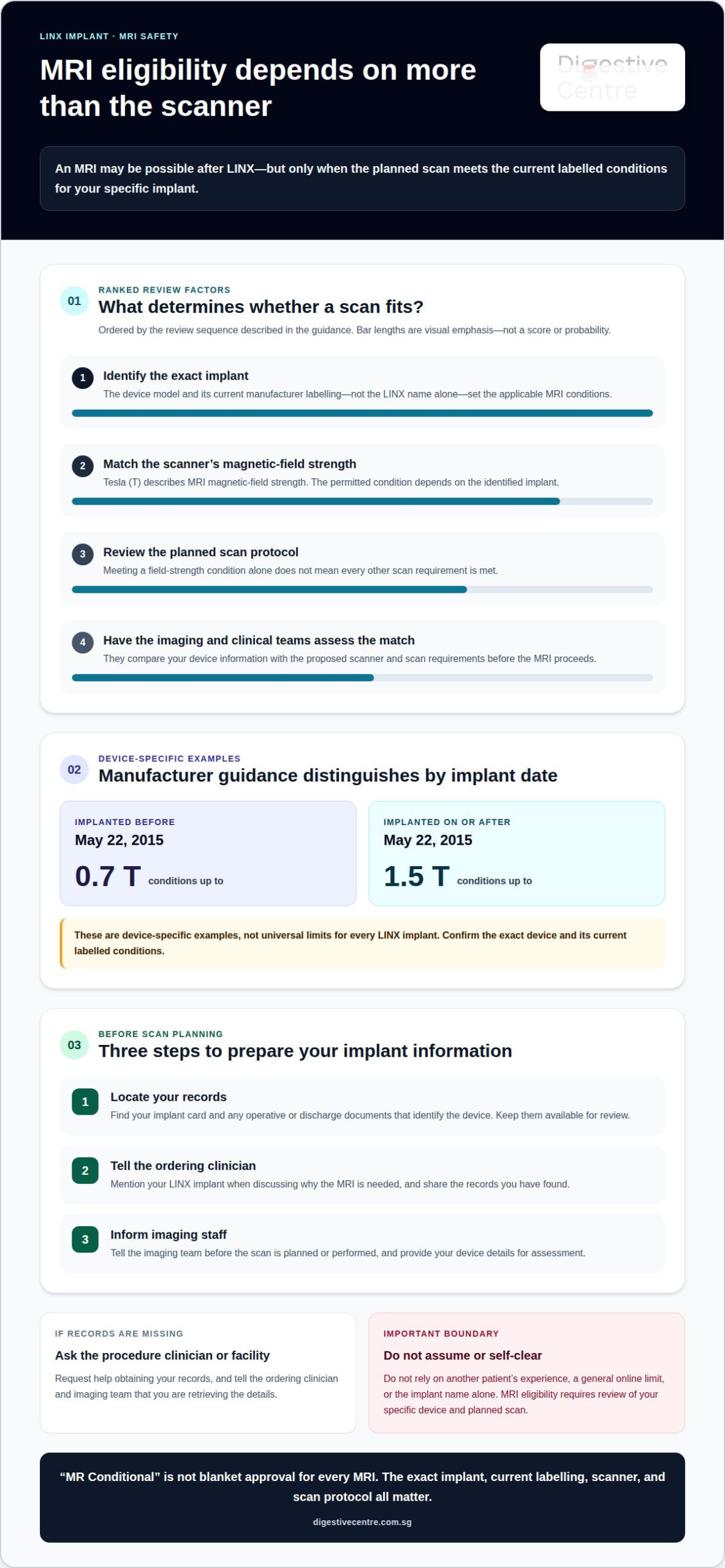
Tesla (T) measures the strength of an MRI scanner’s magnetic field. The scanner’s strength must be considered alongside the conditions for your specific LINX device. Manufacturer guidance distinguishes devices implanted before May 22, 2015, with MRI conditions up to 0.7 T, from devices implanted on or after that date, with conditions up to 1.5 T. These are device-specific examples, not universal limits for every LINX implant.
The scanner’s general MRI capability does not determine your implant’s permitted conditions. The identified LINX model and its current labelling do. If you’re wondering, “is the LINX device MRI safe,” the implant’s identity and the planned scanner and protocol all need to be considered. Meeting a field-strength limit alone does not establish that every scan condition is suitable.
What information identifies your LINX device?
Look for your implant card and keep it with relevant operative or discharge records. These documents may help the clinical and imaging teams identify your device and its placement details. If you can’t find them, tell the ordering clinician and imaging staff that you have a LINX implant so they can determine how to obtain the information needed for review. Don’t rely on memory or another person’s implant details.
Why manufacturer labelling takes priority
Use the current manufacturer labelling for your identified implant to establish the applicable MRI conditions. A third-party summary or older document may describe another device version or conditions that don’t apply to you. The MedlinePlus guide to MRI scans and implant safety explains why MRI screening includes questions about implants, but it does not replace device-specific instructions or an assessment by the imaging team.
Bring available records to your clinical discussion and allow the imaging team and qualified clinicians to assess the planned scan before it goes ahead. If you’re considering LINX for acid reflux, include future imaging needs in your conversation with a reflux specialist. This can inform individual care decisions, but it does not determine MRI eligibility.
What to Do Before an MRI If You Have a LINX Implant
Make sure the people planning and performing your MRI know about your LINX implant. If you’re asking, “is the LINX device MRI safe,” don’t rely on the implant name or another patient’s experience. The imaging team and qualified clinicians need to assess your device information against the planned scan.
Share your implant identification before the imaging team finalises scan planning. Use these steps:
- Locate your records. Find your implant card and any operative or discharge documents that identify the device. Keep them available for review.
- Tell the ordering clinician. Mention your LINX implant when discussing why the MRI is needed, and share the records you have found.
- Inform imaging staff. Tell the imaging team before the scan is planned or performed, and provide your device details so they can assess the applicable conditions.
If you cannot find your implant information
Contact the clinician or facility involved in your LINX procedure to ask about obtaining your records. Tell the ordering clinician and imaging team that you are retrieving the details. The device needs to be appropriately identified, and the proposed scan reviewed by the clinical and imaging teams, before the scan proceeds.
If the requested MRI does not fit the device conditions
Don’t proceed based on an assumption or pressure to keep the original scan plan. Your treating team can discuss whether another diagnostic imaging approach may answer the clinical question. An alternative is not suitable for everyone, so the decision depends on why imaging is needed and your individual circumstances.
If you’re considering LINX for reflux or have questions about your care, discuss LINX treatment with Digestive Centre. A clinical discussion can support informed decisions, but it does not provide MRI clearance.
Discuss LINX and MRI Questions With a Reflux Specialist
A reflux specialist can consider your LINX history alongside the reason an MRI has been requested. This connects your device information with your individual care, but a clinical discussion alone does not clear you for a scan. The imaging team must also review the identified implant and planned MRI conditions before deciding whether the scan can proceed.
Questions to bring to a clinical discussion
Bring the MRI request, implant card or other device records, and details of your LINX procedure if available. These questions may help guide the discussion:
- How can I identify the exact implant I have?
- Where can my current device information be obtained?
- Who will review my implant details against the planned scan?
If you’re asking, “is the LINX device MRI safe,” these questions can clarify what information is still needed and who will review it. Share your records and scan request with your clinician and imaging team, then wait for their assessment before proceeding.
When to seek urgent help
In a Singapore emergency, call 995 or go to the nearest Accident & Emergency department. Do not send urgent medical matters through the website.
This article provides general information only. It is not medical advice, does not create a doctor-patient relationship, and is not a substitute for consultation with a qualified doctor.
For a discussion about LINX for acid reflux and how your treatment history fits into your care, contact Digestive Centre. An enquiry does not book an appointment. Your appointment is confirmed only when the clinic replies with a date and time.
Plan Your Next Conversation With Confidence
Future imaging needs can be part of a thoughtful discussion about reflux care, rather than an afterthought. Instead of relying on a general answer to “is the LINX device MRI safe,” bring your questions to a qualified clinician who can consider your circumstances. Decisions about reflux treatment and later scan review are related conversations, but one does not automatically determine the other.
Digestive Centre provides LINX for acid reflux, with care led by Senior Consultant Surgeon Dr Shanker Pasupathy. If you’re considering this treatment, discuss your reflux concerns and any expected imaging needs with the clinical team. This can help you understand your options without treating general information as individual MRI clearance.
Discuss LINX for acid reflux with Digestive Centre and take a considered next step in your care. For an appointment enquiry, call +65 6737 5388 or email info@digestivecentre.com.sg. An appointment is confirmed only when the clinic replies with a date and time.
Frequently Asked Questions
Is the LINX device MRI safe?
It depends on the exact implant and the conditions for the proposed scan. The device name alone cannot establish whether you are eligible. If an MRI is being arranged, share your records and scan request with the ordering clinician and imaging department, including the intended scanner strength if you know it. Wait for their review rather than treating another person’s clearance as yours.
Can I have an MRI if I do not know which LINX device I have?
Don’t assume the scan is permitted until your implant is identified. Look for an implant card or procedure paperwork. If you can’t find these, contact the clinician or facility involved in your procedure to ask about obtaining your records. If your scan date is approaching, tell the ordering clinician and imaging department that identification is pending so they can advise on planning.
What does Tesla mean for an MRI with LINX?
Tesla, abbreviated T, is the unit used to describe an MRI scanner’s magnetic-field strength. It helps the team compare the planned scanner with the conditions for your specific implant. A number you find online may describe another device or version, so don’t use it to decide independently. Share your implant information and planned scan details for review.
Can I rely on an older LINX patient booklet to decide whether MRI is safe?
An older booklet can provide background and may help identify your device, but it is not personal permission to have an MRI. Keep it with your implant card and procedure records, and provide them to the clinical and imaging teams. They can assess the identified implant using current applicable manufacturer information alongside the details of the requested scan.
Who should I tell about my LINX implant before an MRI?
Tell both the clinician who ordered the MRI and the imaging department, ideally while the scan is being arranged. Mention LINX even if you think it appears in your medical file, and bring your implant card or procedure records. Sharing the information with both teams helps ensure your request is reviewed with your implant history in view.
Medical disclaimer. This guide is general health information from Digestive Centre and is not a substitute for a consultation. Symptoms and treatment options differ from person to person. For advice about your own condition, book a consultation with the clinic. In an emergency, call 995.

































