

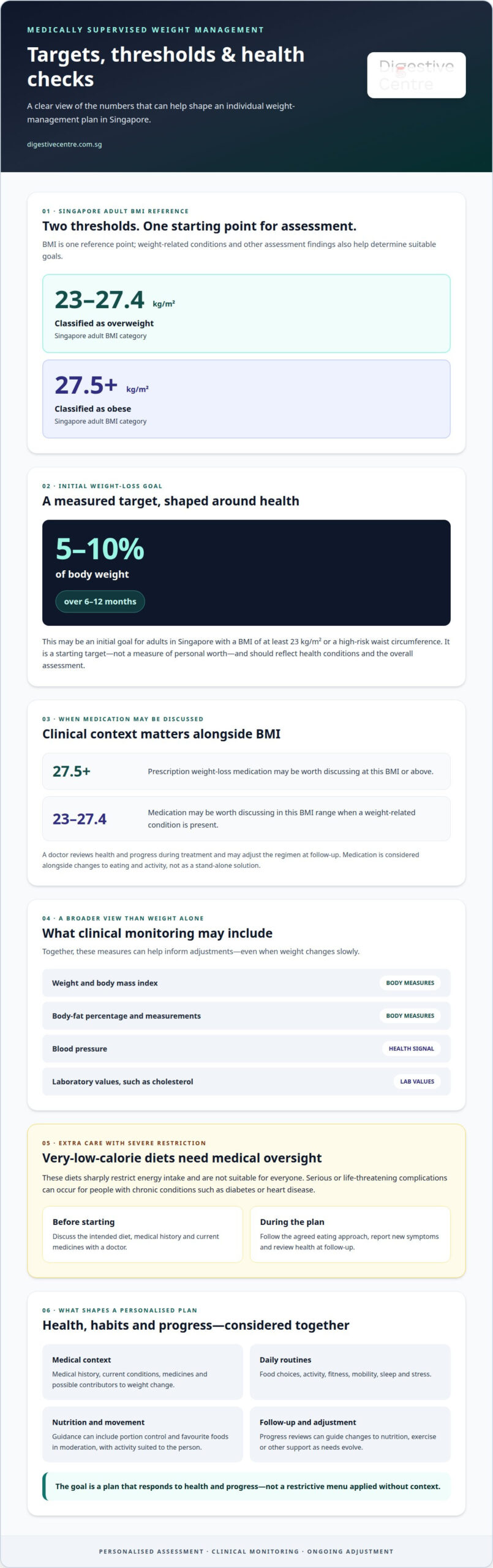
A weight-loss plan should adapt as your health changes. The benefits of a medically supervised diet include personalised guidance, health monitoring and adjustments to nutrition, activity or treatment as your progress and needs evolve. In Singapore, adults with a BMI of 23-27.4 kg/m² are classified as overweight, while a BMI of 27.5 kg/m² or above is classified as obese.
It’s understandable to want more than a restrictive menu. Medical supervision can help identify health factors affecting weight and support changes suited to your medical history, daily habits and fitness level. Very-low-calorie diets require particular care, especially for people with chronic conditions such as diabetes or heart disease, because complications can be serious.
This guide explains what medically supervised weight loss involves, how care can be tailored and what health and quality-of-life improvements may be possible. It also explains when medical oversight matters for very-low-calorie diets, helping you understand the role of professional support in a sustainable approach.
Key Takeaways
- Learn which health measures may be monitored and how follow-up can shape a weight-management plan.
- See how changes to eating, activity, sleep and stress may support health and day-to-day well-being.
- Understand why very-low-calorie diets call for medical oversight, particularly when chronic health conditions are present.
- Explore how personalised guidance can account for medical history, nutritional needs and current fitness.
What Is A Medically Supervised Weight Loss Program?
A medically supervised weight loss program combines health assessment, tailored changes and clinical follow-up. It considers more than calories, helping connect weight loss goals with a person’s health, habits and progress.
Tracking Weight and Health Measures
Monitoring may track weight, body mass index (BMI), body-fat percentage, measurements and blood pressure, alongside laboratory values such as cholesterol. Together, these measures offer a broader view than weight alone and help inform adjustments. For example, changes in body fat or blood pressure may be relevant even when weight changes slowly.
An assessment can also explore why weight has increased or weight loss has been difficult. Possible medical contributors include an underactive thyroid, Cushing’s syndrome, polycystic ovary syndrome (PCOS), depression and medication effects. Age-related changes in hormone production may also play a role. Food choices, activity, sleep and stress can shape daily habits and influence progress, so these factors can be considered when planning care.
Singapore’s BMI categories provide one reference point: adults with a BMI of 23-27.4 kg/m² are classified as overweight, while a BMI of 27.5 kg/m² or above is classified as obese. Weight-related health conditions and other assessment findings also help determine suitable weight loss goals.
Prescription Medication and Monitoring
Prescription weight-loss medication may form part of care when it is clinically appropriate, alongside changes to eating and activity. In Singapore, medication is generally worth discussing at a BMI of at least 27.5 kg/m², or at 23-27.4 kg/m² with a weight-related condition. A doctor reviews health and progress during treatment, then may adjust the regimen at follow-up. Monitoring helps assess response and identify concerns, rather than treating medication as a stand-alone solution.
Insurance coverage varies. Some policies cover medically necessary weight-loss services, but coverage depends on whether a service meets the policy’s definition of medical necessity and on the plan’s terms.
Potential health and quality-of-life improvements
Supervised weight loss may support health goals as well as changes in daily well-being. Some people may feel healthier and more energetic within a few weeks, while progress can also involve building habits that remain manageable beyond the initial weight-loss phase.
An initial assessment considers physical health, medical history, usual food choices and activity level. For example, a plan can account for diabetes, current fitness and mobility before nutrition or exercise changes are recommended. Sleep and stress may also be discussed, since both can shape routines and eating habits.
In Singapore, adults with a BMI of at least 23 kg/m² or a high-risk waist circumference may have an initial goal of losing 5-10% of body weight over 6-12 months. This is a starting target, not a measure of personal worth. Existing health conditions and the person’s overall assessment help shape suitable goals.
Food guidance may include portion control and favourite foods in moderation, rather than an all-or-nothing approach. For emotional eating, identifying triggers and developing alternative coping strategies can support a healthier relationship with food. Addressing emotional and physical health together may make everyday habits easier to sustain.
In Singapore, look for a doctor experienced in weight management or a dietitian with clinical nutrition expertise. Ask how the assessment considers medical history, nutrition and activity, and how follow-up supports changes to the plan.
Care typically begins with a consultation and health assessment, followed by a personalised plan based on health, food choices and activity. Follow-up gives the team an opportunity to review progress and adapt nutrition, exercise or other support as needs change.
For support with medical weight management, a clinical assessment can help connect health goals with an appropriate care plan.
Very-low-calorie diets and medical supervision
Very-low-calorie diets sharply restrict energy intake to support weight loss, but this approach isn’t suitable for everyone. Some diets can cause serious or life-threatening complications for people with chronic conditions such as diabetes or heart disease. A doctor’s assessment can help identify these risks before a restrictive plan begins.
Medical oversight matters because a plan needs to account for existing conditions, current treatment and changes in health. For example, diabetes can affect how a person manages eating and treatment during substantial dietary changes. Heart disease also makes an extremely restrictive approach a concern that requires clinical attention. A doctor reviews these factors and decides whether the approach is suitable.
Risks and side effects depend on the diet and any weight-loss medication used. Very-low-calorie eating can be unsafe for some people with diabetes or heart disease, and weight-loss medicines can also cause side effects. Medical monitoring helps a doctor assess health and respond to changes, rather than treating the diet as a routine menu.
Before starting, discuss the intended diet, medical history and current medicines with a doctor. This allows the clinician to consider diabetes, heart disease and other relevant health concerns. If the risks outweigh the potential value of severe restriction, a less restrictive plan may be considered.
During a supervised plan, follow the agreed eating approach and report new symptoms or difficulty continuing it. At follow-up, the doctor can review health and treatment, then adapt the plan as needed. Continuing a restrictive diet without appropriate oversight can expose someone with a chronic illness to avoidable complications.
Medical supervision doesn’t make every very-low-calorie diet appropriate. It provides a way to assess risk, monitor health and decide whether to continue, change or stop the approach. For people with diabetes or heart disease, this assessment is especially important before making a major change to eating.
How does medical supervision improve weight loss outcomes compared with dieting alone?
A diet followed alone may not account for medical conditions, nutrient needs or changes in mobility. Medical supervision connects these factors with practical weight-loss guidance. The plan can be adjusted as health, fitness and progress change, rather than relying on a fixed set of rules.
Personalisation starts with medical history, diagnoses, eating patterns and exercise needs. For example, someone with limited mobility may begin with a slow walk, while a fitter person may need different activity guidance. A doctor can tailor diet and exercise suggestions to current health and fitness, making them more relevant to daily life.
Follow-up is another important distinction. A doctor can review progress and revise the plan as weight and health change. If an activity feels difficult or a food plan doesn’t fit existing needs, that feedback can inform adjustments. Ongoing review helps keep the approach aligned with the person, rather than leaving them to interpret every setback alone.
Professional support can help build healthy habits during a weight-loss programme. Clear guidance offers practical ways to adapt routines, while continued support can help people work through challenges. Dieting alone may not provide structured feedback when motivation, schedules or health needs change.
Medical supervision doesn’t remove the effort involved. Eating patterns and activity still need to fit everyday life, and progress is reviewed over time. Its value is a plan shaped around medical needs, with opportunities to adapt it rather than treating every person’s weight-loss journey the same way.
Discuss a medically guided weight-loss plan to explore support tailored to your health and goals.
Digestive Centre: GLP1s and Medical Weight management and GLP1s
Digestive Centre provides medical weight management, including GLP1 treatment, for people considering clinical support with weight loss. This may be a relevant next step if lifestyle changes alone haven’t brought progress, or if you want to discuss whether medication belongs in your care plan.
GLP1 treatment is one option within medical weight management, not a stand-alone solution for everyone. Your health goals, medical history and needs are important parts of a discussion about suitable support. A clinician can explain how weight-management options relate to your circumstances and what ongoing medical oversight involves.
If you’re considering medical weight management or GLP1 treatment, contact Digestive Centre to discuss your next step.
Choose a next step that fits your goals
A weight-management plan can be a starting point for lasting changes, not a test of willpower. Consider what you want daily life to look like, such as having more energy for routine activities or feeling more confident about your health. Sharing that priority can help focus a discussion about suitable support.
The benefits of a medically supervised diet are most meaningful when the approach can be adapted to your needs and maintained over time. If you’re considering clinical support, a consultation can clarify which options may suit your goals and what ongoing care involves.
Contact Digestive Centre to discuss your options and take a considered next step towards better-supported weight management.
Frequently Asked Questions
How Soon Will I See Results?
There’s no single timetable that applies to everyone. The pace depends on the approach, health circumstances and how well the plan fits everyday life. Rather than judging progress by one weigh-in, consider whether the plan is practical to continue and whether the outcomes that matter to you are moving in the right direction. Follow-up can help assess progress.
What are the health benefits of a medically supervised diet?
One potential benefit is considering weight-management decisions in the context of broader health goals. This can make conversations about progress more relevant than focusing on appearance or a target number alone. Your priorities might include improving metabolic health or establishing routines you can maintain. The care team can use these priorities to guide discussions about suitable treatment and ongoing goals.
Who should consider a medically supervised diet?
Adults who have struggled to manage weight or want clinical input before choosing a treatment may consider a supervised approach. A BMI of at least 35 is one profile identified for medical weight management. The decision also depends on health needs and treatment suitability, so BMI alone doesn’t determine which approach is appropriate.
What does a medically supervised diet program include?
Programme components depend on the care required. At Digestive Centre, medical weight management can be supported by metabolic testing and nutritional counselling. These services can inform discussions about metabolic health, practical nutrition and weight-management options. The combination is tailored to clinical needs rather than set as a package for every patient.
What tests and health checks are done before starting a supervised diet?
A doctor can screen for existing conditions, including pre-hypertension, before a weight-loss programme begins. This helps identify health considerations that may affect whether an approach is suitable. The assessment can also consider why care is being sought and which treatment is under consideration, so any additional checks are selected in that clinical context.
Medical disclaimer. This guide is general health information from Digestive Centre and is not a substitute for a consultation. Symptoms and treatment options differ from person to person. For advice about your own condition, book a consultation with the clinic. In an emergency, call 995.

































