
Body weight changes the load your knees carry with every step. Understanding how weight affects joint pain starts with this simple link: excess weight can place more mechanical stress on weight-bearing joints and may contribute to inflammation, while gradual weight loss can ease some of that load.
If knee pain makes activity harder, it’s understandable to wonder whether movement will help or worsen the discomfort. The relationship is not a reason to blame yourself. It is useful information for making thoughtful choices about joint care and weight management.
This article explains how excess weight can affect knee osteoarthritis risk and joint loading, and how physical activity and calorie reduction can support weight loss. You’ll also learn why low-impact movement and strengthening exercises may help you stay active while being mindful of your knees.
Key Takeaways
- Excess weight can increase stress on knee joints and may contribute to inflammation that affects joint health.
- Pairing regular, joint-conscious activity with reduced calorie intake can support weight loss more effectively than relying on exercise alone.
- Even modest weight loss can ease the load on your knees during everyday movement.
- Knees and hips bear much of the added load, so understanding which joints are affected can help guide your next steps.
How Does Excess Weight Increase the Risk of Osteoarthritis in the Knees?
Understanding how weight affects joint pain starts with the forces acting on the knees. Each extra kilogram can increase pressure on the knees by around four times, and the knees absorb several times a person’s body weight with each step. One estimate says 10 pounds of excess weight adds 30 to 60 pounds of force per step. These figures describe mechanical loading, not a prediction of when pain or cartilage changes will occur. Repeated loading can make everyday movement more demanding.
How weight affects joint pain involves more than pressure. Fat cells release substances that promote inflammation and may affect joint cartilage. In HANES I data, obese women had nearly four times the risk of knee osteoarthritis compared with non-obese women; obese men had nearly five times the risk. These findings describe risk patterns, not certainty for any individual.
Weight changes over time can matter, too. Among women whose baseline BMI was at least 25, a gain of two BMI units was associated with an odds ratio of 1.28 for later developing knee osteoarthritis. This association does not establish that weight gain alone caused the condition. Cartilage worn down in osteoarthritis cannot regrow, so reducing avoidable strain may help protect function, even though it cannot reverse existing cartilage loss.
Weight loss can address both knee loading and symptoms. Losing at least about 5% of body weight brought meaningful improvement in knee osteoarthritis symptoms. For a woman of normal height, losing 11 lb was associated with a greater than 50% reduction in knee osteoarthritis risk. These findings support gradual weight management as one part of protecting knee comfort and mobility.
Physical activity and calorie reduction
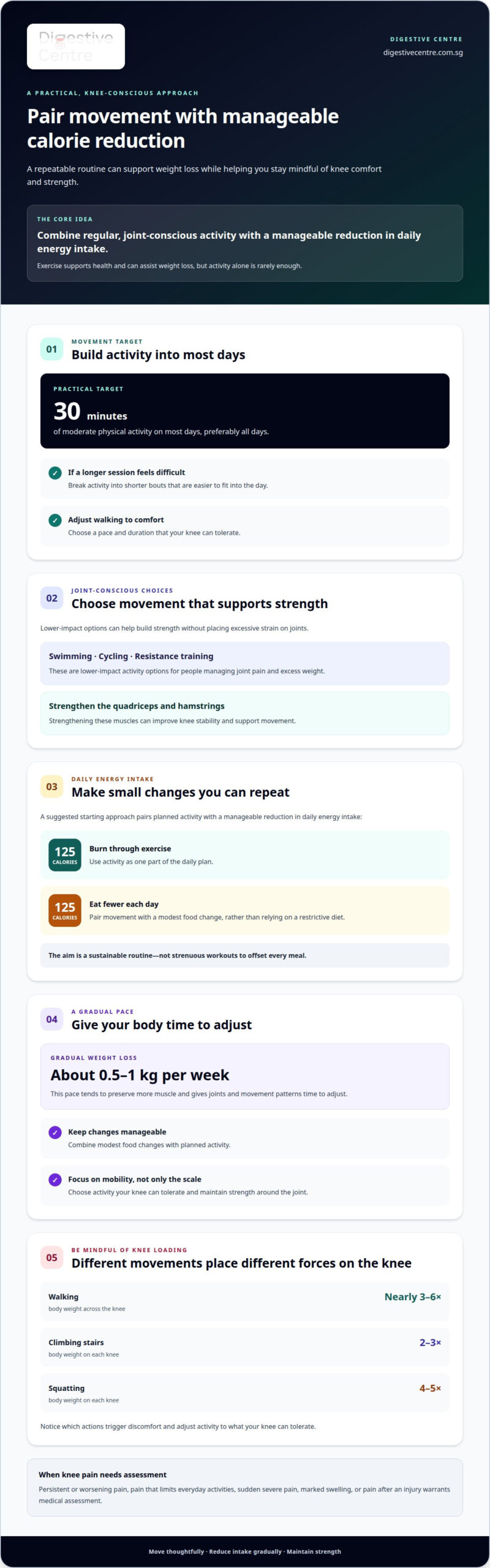
Understanding how weight affects joint pain can help make activity choices more purposeful. Exercise supports health and can contribute to weight loss, but activity alone is rarely enough. A sustainable approach combines movement with a manageable reduction in daily energy intake. For example, one suggested starting approach is to burn 125 calories through exercise and eat 125 fewer calories each day. The aim is a repeatable routine, not strenuous workouts to offset every meal.
Swimming, cycling and resistance training are lower-impact options for people managing joint pain and excess weight. They can help build strength without placing excessive strain on joints. Strengthening the quadriceps and hamstrings can improve knee stability and support movement. In practical terms, activity choices can help maintain strength while limiting unnecessary stress on sore joints.
A practical target is at least 30 minutes of moderate physical activity on most days, preferably all days. If that feels difficult, shorter bouts can make movement easier to fit into the day. Walking is another option, with pace and duration adjusted to comfort. Regular activity has health benefits and can assist weight loss, even though exercise alone is rarely sufficient for weight loss.
Calorie reduction creates an energy deficit. A gradual pace of about 0.5 to 1 kilogram per week tends to preserve more muscle and gives joints and movement patterns time to adjust. Combine modest food changes with planned activity rather than relying on a restrictive diet. For structured support, explore medical weight management.
Weight loss and knee-joint loading
The forces on the knee vary by activity. Walking can place a force of nearly three to six times body weight across the knee. Climbing stairs places two to three times body weight on each knee, while squatting can place four to five times body weight on each knee. This helps explain why a painful knee may cope differently with a short walk, stair climbing or deep bending.
Reducing body weight can lessen the mechanical demand of repeated movement. For someone with knee osteoarthritis, this may make walking and daily tasks easier, although existing cartilage damage does not regrow. The goal is not simply a lower number on the scale. It is to support mobility, choose activity the knee can tolerate and maintain strength around the joint.
Weight-loss medicines and bariatric surgery may support weight management, but they have treatment-specific risks and aren’t direct treatments for knee pain. Their possible benefits for weight and joint loading should be weighed against adverse effects, surgical risks, health history and personal goals. The STEP 9 trial included 407 people with obesity and knee osteoarthritis; semaglutide improved weight and knee pain more than placebo over 68 weeks. That result does not replace an individual assessment of treatment risks.
Arrange a medical assessment if knee pain persists, worsens or limits everyday activities such as walking or using stairs. Sudden severe pain, marked swelling or pain after an injury also warrants prompt attention. A clinician can assess the joint, identify possible causes and discuss suitable next steps rather than assuming weight explains every symptom.
For everyday movement, note which actions trigger discomfort, such as squatting or climbing stairs, and adjust your activity accordingly. Gradual weight loss can reduce the load repeated across the knee with each step. Combining appropriate movement with weight management may support mobility. A clinical assessment can help determine whether osteoarthritis or another joint problem needs attention.
Which joints are most affected by excess weight?
The knees and hips are especially relevant because they support the body when standing and moving. The knee bends and straightens with each step, while the hip helps the leg move in multiple directions. Added body weight can increase the demands on these joints during everyday activities such as walking, getting up from a chair or climbing stairs.
The knee is often the focus in osteoarthritis discussions, but the hip also matters. Overweight individuals are 20 times more likely to need a knee or hip replacement than people who are not overweight. This comparison describes a higher likelihood, not an individual prediction or a diagnosis. Joint symptoms still need to be understood in the context of a person’s overall health and movement.
Other joints may also be affected. Excess weight can strain the muscles, tendons and ligaments that support joints, making movement more difficult. Inflammation may affect more than the knees: substances released by fat cells can affect cartilage, and inflammatory factors associated with weight gain may affect other joints. The location and pattern of discomfort matter, not just the number on the scale.
For example, note whether discomfort centres on a knee when bending, a hip when walking or another joint during movement. This helps describe how symptoms affect daily tasks such as standing, walking or reaching. It also distinguishes a general concern about body weight from a specific joint problem that needs assessment. Excess weight is one risk factor; it does not explain every cause of joint pain.
Considering the knees and hips together gives a clearer picture of weight-related joint risk. Noting which movements are difficult can make a discussion about symptoms more useful. When assessing possible osteoarthritis or other causes, a clinician can consider the affected joint, the pattern of discomfort and its effect on everyday function.
Digestive Centre: GLP1s and Medical Weight management and GLP1s
Digestive Centre offers medical weight management, including GLP1 treatments, for people seeking clinical support with weight loss. If excess weight is making movement difficult or lifestyle changes haven’t achieved the progress you’re aiming for, discuss whether medical options may suit your goals and health needs.
Weight management can be one part of addressing joint loading, alongside appropriate physical activity and nutrition. GLP1 treatment is not a direct treatment for osteoarthritis or a substitute for assessing persistent joint pain. A discussion can help clarify how weight management options may fit your overall care.
For support with medical weight management, contact Digestive Centre to discuss your needs.
Choose a Joint-Friendly Next Step
Make your next step specific: choose a daily movement you’d like to make easier, such as walking to the bus stop or standing comfortably through a meal. Note what you were doing when discomfort began and which adjustments helped. This gives you a practical way to explain your priorities and consider changes that fit daily life, rather than pursuing weight loss as an abstract target. Understanding how weight affects joint pain can help frame that conversation, while recognising that body weight is only one part of joint health.
If you’re considering further support, discuss your weight-management goals and the approaches that may fit your health needs. Digestive Centre offers medical weight management, including GLP1 treatments. Contact Digestive Centre to talk through a possible next step. A thoughtful plan can help you move forward with greater clarity and confidence.
Frequently Asked Questions
How Can You Protect Your Knees?
Protect your knees by choosing activities that keep you moving without repeatedly aggravating discomfort. For example, try cycling or swimming instead of deep squats if bending is painful, and strengthen the muscles around your thighs gradually. Pay attention to how your knees respond during and after activity. If pain is persistent or suddenly severe, seek medical assessment. For a Singapore emergency, call 995 or go to the nearest Accident & Emergency department.
How Does Excess Weight Affect Joint Stress?
Excess weight increases the physical demands on joints that support the body, particularly during movement. The effect varies by activity: the knee experiences different forces while walking, climbing stairs or squatting. Repeated loading can also challenge the muscles and connective tissues that help stabilise a joint. Consider which daily actions trigger symptoms, such as standing from a low chair, and describe that pattern during an assessment.
What Is the Connection Between Obesity and Joint Pain?
Obesity can be associated with joint pain through both increased mechanical loading and inflammation linked with fat tissue. These factors may affect weight-bearing joints and influence comfort during everyday activities. This does not mean obesity is the only cause of pain or that everyone with obesity will develop osteoarthritis. Joint location, symptom pattern, previous injury and overall health all help explain an individual’s experience.
Would My OA Patient Benefit from Losing Weight?
Some people with osteoarthritis may benefit from weight loss, particularly when excess weight adds strain during daily movement. The value of a plan depends on the person’s mobility, nutrition, strength and health needs. A practical goal might be making a regular task, such as walking around the home, more comfortable while maintaining muscle. This content is general information only, not medical advice, and is not a substitute for consultation with a qualified doctor.
How does excess body weight increase joint pain?
Extra body weight can increase the effort required from joints and their supporting tissues, especially during repeated tasks. For example, standing for a long time or carrying groceries may feel harder when your knees or hips are already painful. Inflammation associated with fat tissue may also affect joint tissues. Pain can have other causes, so its timing, location and effect on function are useful details to describe.
How much does each kilogram of weight loss reduce knee joint load?
That finding shows an association and does not establish an exact reduction for every person. Knee loading also varies by movement, so walking and stair use may not produce identical forces.
Medical disclaimer. This guide is general health information from Digestive Centre and is not a substitute for a consultation. Symptoms and treatment options differ from person to person. For advice about your own condition, book a consultation with the clinic. In an emergency, call 995.

































