
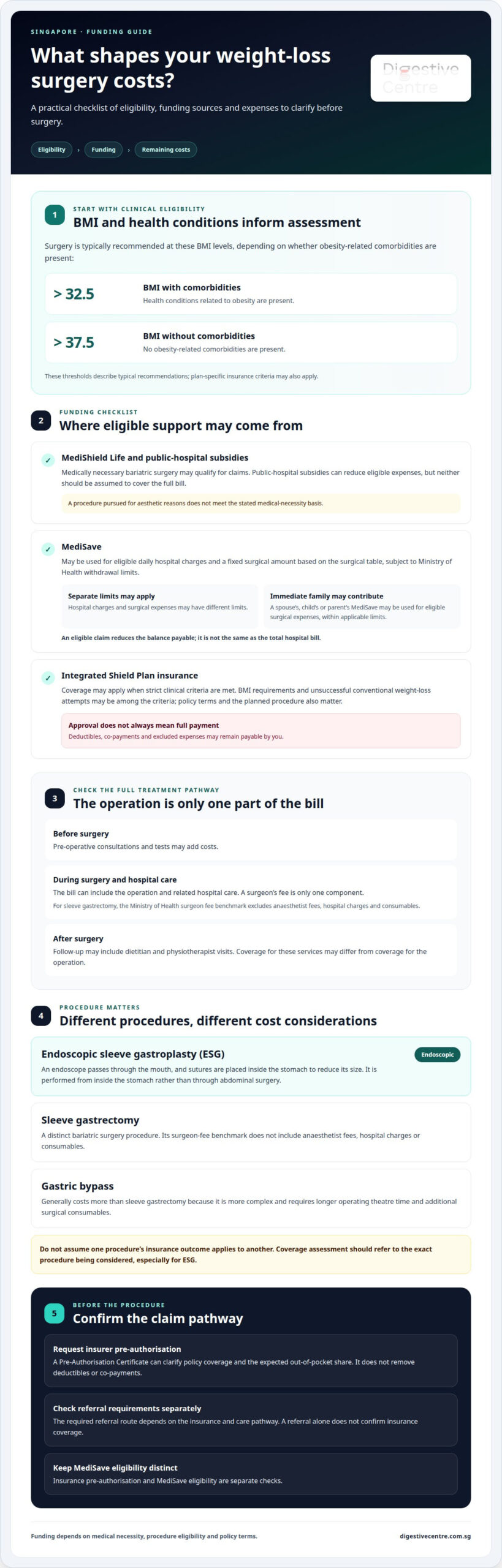
Insurance coverage for weight loss surgery in Singapore may apply when the procedure is medically necessary and you meet your plan’s clinical criteria, but it doesn’t necessarily cover the full bill. MediShield Life and MediSave may also help with eligible expenses, subject to applicable limits. BMI is part of the assessment: surgery is typically recommended at a BMI exceeding 32.5 when comorbidities are present, or over 37.5 without comorbidities.
It’s understandable to want a clear picture of what you may need to pay before considering surgery. This guide explains how private insurance, government subsidies and MediSave may contribute, why full coverage is not automatic, and how BMI and health conditions can affect eligibility. It also compares sleeve gastrectomy, gastric bypass and endoscopic sleeve gastroplasty, helping you understand which costs and funding rules may apply to your treatment pathway.
Key Takeaways
- Understand how MediSave and public-hospital subsidies may reduce eligible expenses, and why withdrawal limits matter.
- See why insurance approval may not cover every cost, including deductibles, co-payments and care around surgery.
- Compare how endoscopic sleeve gastroplasty, sleeve gastrectomy and gastric bypass differ before considering a treatment path.
- Learn how BMI and obesity-related health conditions can shape whether bariatric surgery is considered.
Government subsidies and MediSave payouts
In Singapore, medically necessary bariatric surgery may qualify for MediShield Life and MediSave claims; aesthetic procedures do not meet this stated basis. Public-hospital subsidies and MediSave can reduce eligible expenses, but may not cover the entire bill.
Subsidy and MediSave Eligibility
Eligibility depends on whether surgery is medically necessary and whether the procedure and expenses qualify under the relevant scheme. This distinction matters because a weight-loss procedure pursued for aesthetic reasons may not qualify on the same basis.
These figures reflect subsidised bills, not a guaranteed amount for an individual admission.
MediSave Claim and Withdrawal Limits
MediSave may be used for daily hospital charges and a fixed surgical amount based on the surgical table, subject to Ministry of Health withdrawal limits. Certain bariatric procedures may qualify for claims within these limits.
The amount available depends on the procedure and type of charge. Separate limits may apply to hospital charges and surgical expenses, so a MediSave claim can reduce the balance payable without covering every item. The eligible claim amount is not the same as the total hospital bill.
Using MediSave for Immediate Family
MediSave may also be used for surgical expenses incurred by a patient’s spouse, children or parents, subject to Ministry of Health withdrawal limits. This can help families plan payment when the patient’s own MediSave is not the only account being considered.
For example, a spouse’s MediSave may contribute to eligible surgical expenses, but the applicable limits still govern the amount that can be withdrawn. Family support does not remove the procedure’s eligibility requirements.
Pre-authorisation and Referral Requirements
For insurance claims, obtain a Pre-Authorisation Certificate from the insurer before bariatric surgery. It can clarify the plan’s coverage and expected out-of-pocket share, but is separate from MediSave eligibility.
Referral requirements depend on the insurance and care pathway. Arrange the insurer’s pre-authorisation before surgery and establish the required referral route for the intended claim. A referral alone does not confirm insurance coverage, and a certificate does not remove policy deductibles or co-payments.
Does insurance cover the full bariatric surgery Singapore cost?
Integrated Shield Plans may cover bariatric surgery when strict clinical criteria are met, but the policy may still leave deductibles, co-payments or excluded expenses. Insurance coverage for weight loss surgery in Singapore depends on the policy, clinical criteria and planned procedure. Public-hospital bill data includes sleeve gastrectomy cases at Khoo Teck Puat Hospital and Ng Teng Fong General Hospital, but this does not establish acceptance under every insurance plan.
Surgery and Procedure Costs
Surgery costs include the operation and related hospital care, with the procedure and care setting shaping the bill. A surgeon’s fee is only one component of the overall expense.
For sleeve gastrectomy, the Ministry of Health surgeon fee benchmark excludes anaesthetist fees, hospital charges and consumables. Public-hospital bill figures reflect different care components and subsidies where applicable. Gastric bypass generally costs more than sleeve gastrectomy because it is more complex and requires longer operating theatre time and additional surgical consumables.
Pre-operative and Follow-up Costs
Pre-operative and follow-up costs cover assessment before surgery and continuing care afterward. They matter because the operation’s bill may not represent the full treatment pathway.
Allow for pre-operative consultations and tests, as well as post-operative dietitian and physiotherapist visits. These services support preparation, recovery and follow-up, but coverage may differ from the operation’s benefits. Listing each care component separately helps clarify potential out-of-pocket costs without treating every expense as part of one surgical charge.
Insurance Coverage and Out-of-Pocket Costs
Insurance coverage is the portion paid under the policy; out-of-pocket costs are expenses left to you. This explains why approval does not necessarily mean full payment.
Most Integrated Shield Plans cover bariatric surgery when patients meet strict clinical criteria, including BMI requirements and unsuccessful conventional weight-loss attempts. Deductibles and co-payments may still apply. Insurance coverage for weight loss surgery in Singapore also depends on policy terms, exclusions and the expenses included in the claim. A Pre-Authorisation Certificate can clarify expected coverage before surgery.
Consider the procedure, hospital care and follow-up as separate parts of the treatment pathway. A bariatric surgery assessment can help clarify the clinical plan, giving you a defined procedure to discuss with your insurer.
Endoscopic sleeve gastroplasty, sleeve gastrectomy and gastric bypass
These procedures use different approaches, so their names matter when considering treatment and insurance assessment. Endoscopic sleeve gastroplasty (ESG) uses an endoscope passed through the mouth, with sutures placed inside the stomach to reduce its size. Sleeve gastrectomy and gastric bypass are distinct bariatric surgery procedures. Their differences mean you should not assume that one procedure’s coverage outcome applies to another.
ESG is performed from inside the stomach rather than through abdominal surgery. The endoscope allows the clinician to place internal sutures and create a smaller stomach. This distinguishes ESG from sleeve gastrectomy, but does not establish how an individual insurance policy classifies or covers ESG. Insurance assessment should refer to the exact procedure being considered, not simply the broad goal of weight loss.
Sleeve gastrectomy and gastric bypass are separate surgical options, and gastric bypass is generally more complex. It typically requires longer operating theatre time and additional surgical consumables than sleeve gastrectomy. These differences can affect the components of a hospital bill. They also make it important to use the correct procedure name when discussing expected coverage and eligible expenses with an insurer.
For a practical comparison, consider someone weighing treatment options after conventional weight-loss attempts. ESG involves endoscopic suturing; sleeve gastrectomy and gastric bypass are surgical procedures with different operative requirements. The clinical assessment considers the person’s health and proposed procedure, while coverage assessment considers the insurer’s policy terms and the procedure named in the treatment plan. Shared purpose or similar-sounding names do not make the procedures interchangeable for a claim.
Before a claim is assessed, identify whether the proposed treatment is ESG, sleeve gastrectomy or gastric bypass. Keep the procedure name consistent across the treatment plan and insurance documents. A Pre-Authorisation Certificate can clarify how the insurer assesses the planned procedure before treatment. This distinction separates clinical choice from payment expectations and keeps the discussion focused on the actual procedure, rather than a general label such as weight-loss treatment.
BMI thresholds for surgery assessment
In Singapore, BMI and obesity-related conditions help shape bariatric surgery assessment. Surgery is typically recommended for people with a BMI exceeding 32.5 when comorbidities are present, or over 37.5 without comorbidities. These thresholds offer a useful starting point, but they describe different clinical situations.
The 32.5 threshold applies when a person has comorbidities alongside a higher BMI. For example, a person with a BMI of 33 and an obesity-related health condition falls above this stated threshold. The 37.5 threshold applies when comorbidities are absent. A BMI of 38 is above that threshold, while a BMI of 36 is not. These examples illustrate the figures, not a personal recommendation.
Comorbidities matter because the recommendation changes depending on whether they are present. Read the thresholds together, rather than treating them as a single BMI cutoff for everyone. A person below one threshold may still need an assessment of their health, while a BMI above a threshold does not by itself establish that surgery is appropriate. Clinical assessment considers the full health context.
BMI also factors into insurance assessment. Integrated Shield Plan coverage may involve strict clinical criteria, including BMI requirements and unsuccessful conventional weight-loss attempts. Meeting a threshold alone does not establish that a policy will cover surgery. The planned procedure, clinical rationale and policy terms also affect how a claim is considered. Understand BMI information alongside the treatment plan, rather than treating it as a promise of coverage.
For a useful assessment, discuss your BMI, related health conditions and previous conventional weight-loss efforts as part of the same clinical conversation. Then align the proposed bariatric surgery with the insurer’s criteria and pre-authorisation process. This links the health assessment to the coverage question without assuming that one BMI value determines the outcome.
If you’re considering surgery, book a bariatric surgery assessment to discuss how BMI and related health conditions inform the treatment plan.
Digestive Centre: GLP1s and Medical Weight management and GLP1s
Digestive Centre can help you explore medical weight management options if surgery isn’t your preferred next step or you’re considering alternatives. Its care options include GLP-1 treatments and gastric balloon procedures, alongside support for related digestive concerns through gastroscopy and colonoscopy, GERD and acid reflux treatment, and LINX for acid reflux.
Your next step can be a discussion of your health goals, previous weight-management approaches and treatment options. If bariatric surgery remains under consideration, discuss the clinical plan and insurance assessment alongside other pathways. Coverage differs by treatment and policy, so the procedure or service being considered matters.
Contact Digestive Centre to discuss medical weight management and the treatment options relevant to your care.
Choose a next step that fits your health goals
Understanding insurance coverage for weight loss surgery in Singapore is one part of planning care. Next, connect your health priorities with a treatment pathway and discuss the practical questions that matter to you and your family. Your financial responsibility depends on your policy and treatment plan, so consider these alongside your clinical goals.
Digestive Centre can discuss medical weight management, including GLP-1 treatments, and care for related digestive concerns. Its services also include gastroscopy and colonoscopy, as well as GERD and acid reflux treatment. This can be useful if you’re weighing different approaches or want to discuss digestive symptoms as part of your wider health needs.
Take the next step at a pace that feels right for you. Discuss your options with Digestive Centre and start a considered conversation about care that aligns with your goals.
Frequently Asked Questions
Are there hidden costs involved in the procedure?
Additional expenses can arise from care outside the main procedure charge. Pre-operative consultations and tests, anaesthetist fees, hospital charges and consumables may be billed separately. Follow-up care, including dietitian and physiotherapist visits, can also add to total spending. Before treatment, map out the full care pathway and identify which items your policy includes to estimate your personal contribution more clearly.
How Does MOH Determine Eligibility For Bariatric Surgery?
In Singapore, BMI and related health conditions are key considerations in bariatric surgery assessment. Surgery is typically recommended for people with a BMI exceeding 32.5 when they have comorbidities, or over 37.5 when they don’t. These thresholds describe different clinical situations, not an automatic approval rule. Insurance assessment may also consider clinical criteria and previous conventional weight-loss attempts, so BMI alone doesn’t determine coverage.
Why is the cost in Singapore higher than in neighbouring countries?
You cannot assume that Singapore’s cost is always higher without comparing equivalent care. A meaningful comparison uses the same procedure, hospital setting and included charges. For instance, a quoted surgical fee may exclude hospital charges, anaesthesia and consumables, while another figure may cover more of the admission. Procedure complexity and level of care also affect the total, so compare itemised estimates rather than headline figures.
Does MediShield Life cover bariatric or weight loss surgery in Singapore?
MediShield Life may cover bariatric surgery when it is medically necessary rather than aesthetic, subject to applicable eligibility and claim conditions. The procedure must also meet the scheme’s requirements; the general purpose of weight loss alone does not establish eligibility. Separate funding routes, including MediSave, may apply to eligible expenses. Keep the proposed procedure and medical rationale clear when reviewing how your treatment may be funded.
Does company health insurance in Singapore cover weight loss surgery?
Company health insurance coverage depends on the specific group policy, its benefits and exclusions, and the clinical criteria for the proposed treatment. Do not assume an employer plan follows the same terms as an Integrated Shield Plan. Review the policy’s surgical benefits and pre-authorisation requirements with your insurer or benefits administrator before arranging surgery. Ask how deductibles, co-payments and related hospital expenses affect your share of the bill.
How much does gastric sleeve or gastric bypass surgery cost in Singapore?
The price depends on the case and is given after a quote request; the procedure, hospital care and associated charges affect the total. Gastric bypass generally costs more than sleeve gastrectomy because it is more complex and requires longer operating theatre time and additional surgical consumables. For a useful estimate, distinguish the surgeon’s fee from hospital charges, anaesthesia, consumables and follow-up care.