

Gastrointestinal side-effect estimates can rise as doses increase: one titration model places the risk at about 8% during the starting phase and 17% during continued escalation. A typical semaglutide GLP-1 medication titration schedule starts at 0.25 mg once weekly for four weeks, then steps up every four weeks through 0.5 mg, 1 mg and 1.7 mg, reaching 2.4 mg from week 17. The gradual pace gives the body time to adapt.
It’s understandable to expect weight loss to begin quickly or to worry when nausea, diarrhoea or constipation occurs during dose increases. Early progress can be modest, and gastrointestinal effects are most common while doses are rising. If a dose is difficult to tolerate, a slower increase may be considered.
This article explains why treatment starts at a low dose, what weight-loss estimates may look like during titration, and how to interpret modelled gastrointestinal-risk figures without treating them as personal predictions. It also compares commonly used semaglutide and tirzepatide schedules and explains why dose changes should follow clinical guidance, not a self-adjusted plan.
Key Takeaways
- Starting at a low dose and increasing gradually gives the body time to adjust while tolerance is assessed.
- Semaglutide trial doses increased every 4 weeks, progressing through higher weekly doses, according to the U.S. National Library of Medicine.
- Weight-loss estimates change across treatment phases, so early progress may not reflect later results.
- Gastrointestinal effects can be more noticeable as doses rise; learn what to monitor and why dose changes shouldn’t be made independently.
Why GLP-1 treatment starts at a low dose
GLP-1 treatment starts low, then increases in stages to support tolerance. A dose schedule is a clinical plan, not a target to accelerate independently.
Starting Dose and Weekly Administration
A starting dose introduces treatment gradually; one semaglutide example begins at 0.25 mg once weekly. Keeping to the prescribed weekly plan makes it easier to notice changes in tolerance.
Schedules vary by active ingredient, formulation and treatment purpose. Semaglutide, liraglutide, tirzepatide and dulaglutide each have distinct instructions, so don’t apply one medicine’s schedule to another. In Singapore, medication costs depend on the medicine, dose and treatment plan; insurance coverage depends on the policy’s terms and benefits.
Gradual Escalation and Tolerance
Gradual escalation means increasing the dose in planned steps rather than starting at a higher level. Time at each dose allows tolerance to be assessed before the next increase.
This matters because gastrointestinal effects can occur during treatment. Report side effects early, and don’t change your dose based on outside information. Monitoring includes tracking symptoms and discussing them with the prescribing clinician before a planned increase. In Singapore, approval and dosing instructions are specific to each medicine and formulation.
Adjusting Doses for Tolerability
Dose adjustment means changing the timing or amount of an increase to address tolerability. If a dose causes troublesome effects, the next increase may be delayed rather than taken automatically.
Note when symptoms occur in relation to each dose, then share the pattern with the clinician overseeing your treatment. This gives you a clearer basis for discussing the next step. Don’t compensate by skipping, increasing or otherwise changing doses without guidance, even if an outside schedule suggests faster progression. For those pursuing personalized, clinician-guided care for women’s health and longevity, platforms like peptela.com emphasize the importance of closely monitored, individualized protocols rather than self-directed dosing.
Semaglutide Dose Escalation
Semaglutide escalation uses successive weekly dose levels. According to U.S. National Library of Medicine, the trial’s semaglutide dose escalation increased every 4 weeks to 0.5, 1.0, 1.7, and 2.4 mg/week.
This trial sequence illustrates staged increases, not a universal instruction for every formulation or treatment purpose. For a specific semaglutide prescription, follow the relevant instructions and discuss tolerance before changing the planned dose.
Weight-loss estimates during titration
Weight change during titration is best read as a trend, not a weekly verdict. A GLP-1 medication titration schedule shows dose stages, but it doesn’t predict an individual result. Early scale readings can differ from later progress as treatment continues. Eating patterns, activity and the treatment phase also affect what the scale shows.
In the STEP 1 trial, semaglutide treatment was associated with an average body-weight reduction of approximately 15% over 68 weeks. Lifestyle changes alone were associated with an average 2.5% body-weight loss in the comparison reported. These are study averages across a defined period, not a forecast for each person or a guaranteed difference between approaches.
A titration simulator separates estimates by treatment phase. It estimates approximately 0% weight loss during adaptation, around 2% after the first dose increase, and about 6% during continued titration. Its estimated final weight loss is approximately 15% across slow and fast schedules. These are model outputs, not trial measurements at each milestone, so don’t interpret them as expected results for a particular week.
Compare measurements over time under similar conditions, and note the treatment stage alongside each reading. A flat result on one day differs from a sustained pattern across several weeks. The GLP-1 medication titration schedule can help put a measurement in context, while notes about changes in eating or activity may help explain shifts in the trend.
If you miss a dose, don’t compensate by taking extra or changing the next dose on your own. Record the interruption and follow the instructions for your specific medicine. Sharing this detail with your prescriber helps distinguish a change in treatment routine from a change in weight trend, keeping the discussion focused on what happened and what to do next.
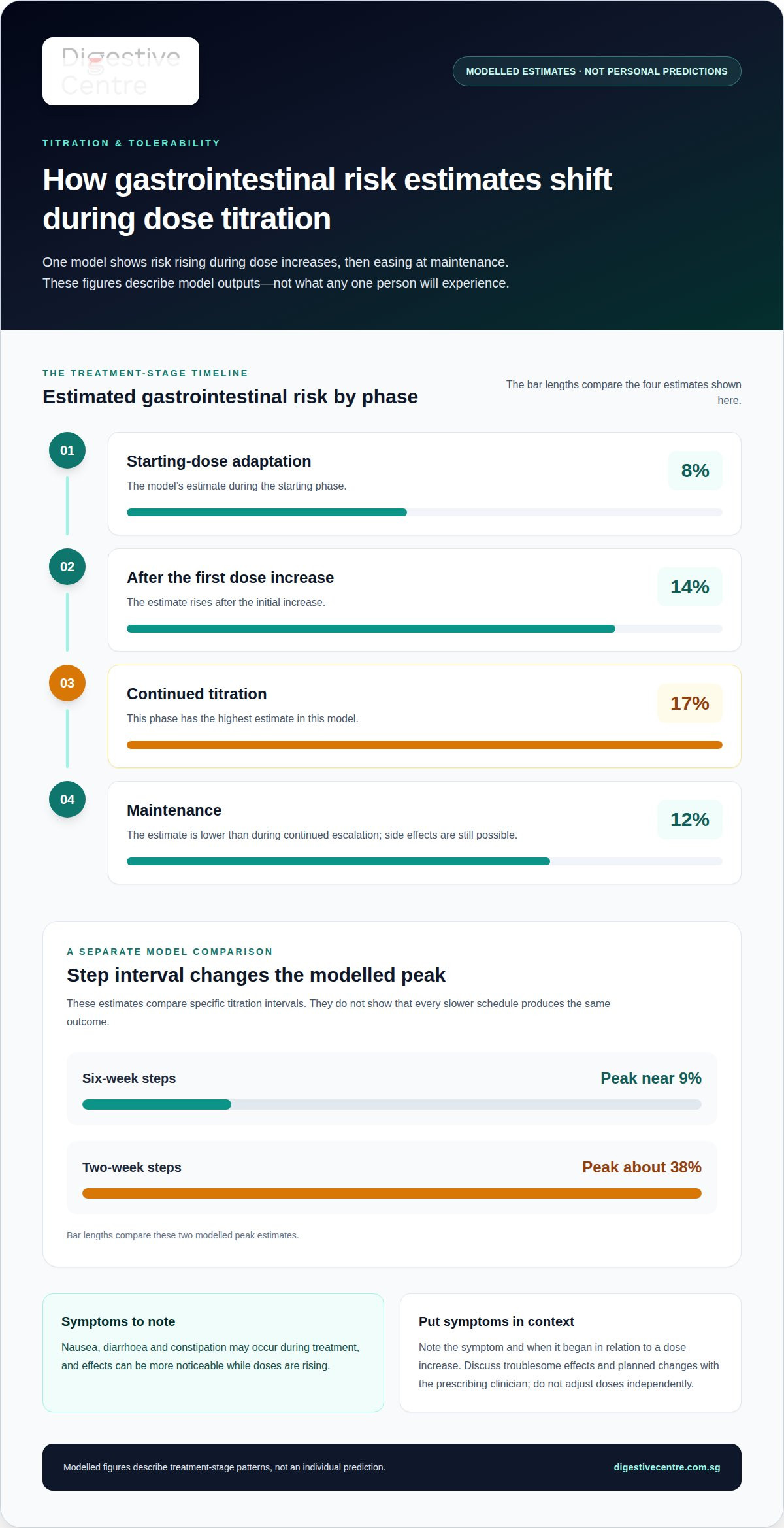
Gastrointestinal side-effect estimates
Gastrointestinal side effects often become more noticeable while GLP-1 doses rise. Nausea, diarrhoea and constipation can affect comfort during titration. A model estimates about 8% gastrointestinal risk during the starting-dose adaptation phase. After the first dose increase, its estimate rises to about 14%. These figures show how the model’s estimates vary across treatment stages.
The same model estimates approximately 17% gastrointestinal risk during continued titration, then about 12% at maintenance. The peak estimate therefore falls after the escalation phase in this model. Maintenance doesn’t mean side effects are impossible; it marks a different dosing stage. Read the estimates as modelled figures, not as a personal measurement or a prediction of precisely what one person will experience.
Step timing also changes the modelled peak. With six-week titration steps, it estimates a peak near 9%. With two-week steps, the estimate reaches about 38%. This comparison illustrates why faster increases may carry a different side-effect profile. The figures don’t establish that every slower schedule produces the same outcome; they compare specific intervals in the model.
For practical tracking, note the symptom, when it began and whether it followed a dose increase. For example, record nausea after an increase separately from constipation that persists between doses. This timeline gives a clinician clearer information than a general note that treatment feels difficult. Report side effects early rather than waiting until the next planned increase to raise concerns.
Don’t change your dose based on model estimates or outside information. Share the symptom pattern with your prescribing clinician, who can consider your tolerance before the next step. If diarrhoea or constipation occurs, include its timing and persistence in the discussion. Separating adaptation, escalation and maintenance makes estimates easier to interpret, while keeping dose decisions tied to your actual response.
What are the standard dose titration schedules for semaglutide, liraglutide, tirzepatide, and dulaglutide?
These four active ingredients don’t share one interchangeable schedule. Dose steps depend on the specific medicine and formulation. The examples below show why it matters to check the ingredient before interpreting a plan.
In a semaglutide trial, the weekly dose increased every 4 weeks to 0.5, 1.0, 1.7, and 2.4 mg, according to the U.S. National Library of Medicine. This sequence describes that trial’s escalation, not a schedule to apply to every semaglutide product or treatment plan. The dose and pace should match the instructions for the prescribed formulation.
For tirzepatide, an escalation example starts at 2.5 mg weekly for weeks 1 to 4. It then progresses to 5 mg in weeks 5 to 8, 7.5 mg in weeks 9 to 12, and 10 mg in weeks 13 to 16. The next step is 12.5 mg in weeks 17 to 20, followed by 15 mg from week 21 onward. Increases are spaced by at least four weeks at each dose. Listed maintenance doses are 5 mg, 10 mg and 15 mg.
Liraglutide and dulaglutide have their own dosing instructions; neither follows the semaglutide or tirzepatide sequence above. The schedule details available here don’t establish their step-by-step doses, so don’t assume the same starting amount, interval or target. A medicine’s formulation and intended use shape its instructions.
Compare schedules by active ingredient, starting dose, interval between increases and maintenance options. For example, the semaglutide trial sequence uses four-week steps, while the tirzepatide example holds each dose for at least four weeks. These similarities don’t make the medicines interchangeable. Follow your prescribed plan and report side effects before changing a dose or increase date.
The semaglutide example increases the weekly dose every four weeks, while the tirzepatide example starts at 2.5 mg weekly and holds each dose for at least four weeks before increasing; its listed maintenance doses are 5, 10, and 15 mg. These examples are not interchangeable schedules, and dosing depends on the specific formulation and prescribed plan.
Digestive Centre: Gastroscopy and colonoscopy
Digestive Centre offers medical weight management, including GLP-1 treatment, alongside gastroscopy and colonoscopy. If gastrointestinal symptoms are affecting your comfort during treatment, discussing them with a medical team can help clarify what assessment may be appropriate. Gastroscopy and colonoscopy are diagnostic services, while medical weight management addresses treatment planning. The relevant next step depends on the concern you want assessed, such as persistent digestive symptoms or questions about weight-management treatment. Share your symptoms and current medication plan during your discussion, including any side effects and when they occur. This context can help guide a focused conversation about care. Contact Digestive Centre to discuss your concerns and the available services.
Make your next treatment discussion more useful
A clear record can make your next conversation about treatment more focused. Note when symptoms occur, how they relate to dose changes, and what questions you want answered. This context helps keep attention on your experience rather than relying on a schedule alone. Use your GLP-1 medication titration schedule as a reference for discussion, not as a reason to adjust doses independently.
Consider what you need help with next: understanding a treatment plan, discussing gastrointestinal symptoms, or exploring medical weight management. Digestive Centre offers GLP-1 treatment and medical weight management, as well as gastroscopy, colonoscopy, and GERD and acid reflux treatment. These services address different concerns, so describe the issue that matters most to you when you get in touch.
Contact Digestive Centre to discuss your next step. A considered conversation can help you move forward with greater clarity and confidence.
Frequently Asked Questions
How long should each GLP-1 medication dose be taken before increasing it?
Many escalation examples keep each dose in place for at least four weeks before increasing it. A semaglutide trial advanced doses every four weeks, while tirzepatide increases are spaced by at least four weeks at each dose. The exact interval depends on the medicine and prescribed plan. If an increase causes troublesome effects, report them before moving to the next scheduled dose.
What are the approved starting and maximum doses of GLP-1 medications for diabetes and weight management?
There isn’t one starting or maximum dose shared across all GLP-1 medicines and indications. In weight-management schedule examples, semaglutide starts at 0.25 mg weekly and reaches 2.4 mg; tirzepatide starts at 2.5 mg, with maintenance options of 5 mg, 10 mg and 15 mg. These examples don’t define diabetes dosing or establish a universal dose limit. Follow the instructions for the specific prescribed medicine.
How should a GLP-1 dose be titrated if nausea or other side effects occur?
Report nausea or other side effects before increasing your dose, and don’t adjust it yourself. Under the semaglutide schedule described in its prescribing information, a dose increase may be delayed by four weeks if the current dose isn’t tolerated. Keep a brief record of symptoms and their timing, including whether they began after an increase, to support a clear discussion about the next step.
What are the risks of increasing a GLP-1 dose too quickly?
Faster increases may raise gastrointestinal side-effect risk during escalation. One titration model estimates a peak near 38% with two-week steps, compared with about 9% using six-week steps. These are model estimates, not individual predictions. Nausea, diarrhoea or constipation can make treatment harder to tolerate, so report symptoms and avoid advancing doses ahead of the prescribed schedule.

































