
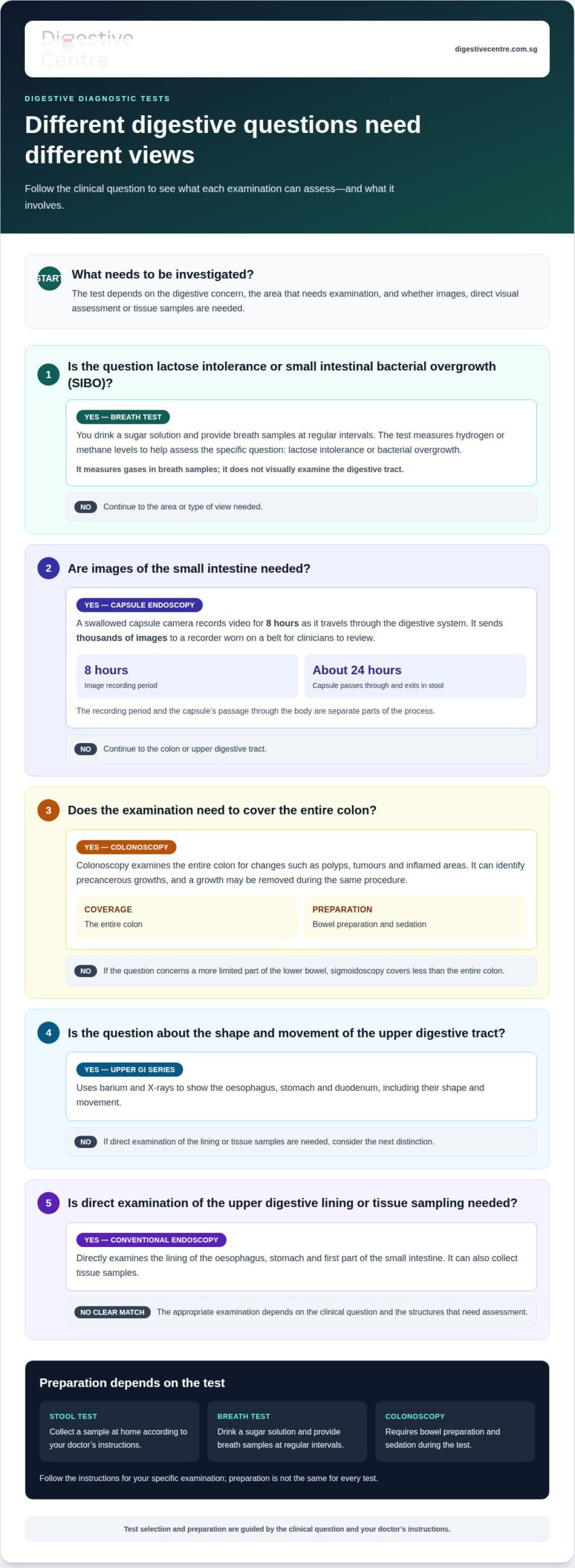
Digestive symptoms need the right test, not a one-size-fits-all answer. Diagnostic tests for digestive issues may include breath tests, capsule endoscopy or colonoscopy, depending on what doctors need to investigate. Breath tests measure hydrogen or methane after you drink a sugar solution; capsule endoscopy captures images as a swallowed camera travels through the digestive system; colonoscopy examines the entire colon and can identify and remove precancerous growths.
It’s natural to want to know what a test involves and how to prepare, especially when the procedure is unfamiliar. Preparation varies: a stool test involves collecting a sample at home according to your doctor’s instructions, while colonoscopy requires bowel preparation and sedation during the test.
This guide explains what different examinations can help investigate and what to expect beforehand. You’ll learn how breath tests assess lactose intolerance and small intestinal bacterial overgrowth, what capsule endoscopy can reveal in the small intestine, and how colonoscopy examines the colon. Knowing how each test works can make preparation more manageable.
Key Takeaways
- Match the test to the question being investigated, from food intolerance and bacterial overgrowth to changes in the colon.
- Learn what capsule endoscopy can reveal about parts of the digestive tract that other examinations may not show as clearly.
- Use your doctor’s preparation instructions to plan for sample collection, bowel cleansing and sedation.
- Understand how gastroscopy and colonoscopy can support further assessment when digestive symptoms need investigation.
Breath tests for lactose intolerance and bacterial overgrowth
Breath tests help investigate lactose intolerance and small intestinal bacterial overgrowth by measuring hydrogen or methane. For both, you drink a sugar solution and provide breath samples at regular intervals.
Testing for Lactose Intolerance
A lactose breath test measures hydrogen or methane in your breath after you drink a sugar solution. Samples are collected at regular intervals to track changes over time, giving clinicians information to assess whether lactose may be linked to your digestive symptoms.
The test measures gas levels in successive breath samples rather than visually examining the digestive tract. If symptoms follow foods containing lactose, for example, a breath test can help investigate lactose intolerance. It assesses your response during the test; it does not examine the colon or collect tissue samples.
Testing for Bacterial Overgrowth
A breath test can also help investigate small intestinal bacterial overgrowth, often shortened to SIBO. As with a lactose test, you drink a sugar solution and breathe into a collection device at regular intervals. Hydrogen or methane levels in the samples are measured as part of the assessment.
The two tests share a collection method, but they investigate different digestive concerns: lactose intolerance and bacterial overgrowth. That distinction helps explain why a breath test is selected for a particular question rather than used as a general examination of the digestive system. The results provide information about measured gases; other tests, such as colonoscopy, examine different areas and features.
Capsule endoscopy for the small intestine
Tests provide different views of the digestive tract. Capsule endoscopy captures images as a camera travels through the small intestine, while an upper GI series uses barium and X-rays to show the oesophagus, stomach and duodenum. Endoscopy examines the lining directly and can collect tissue samples.
With capsule endoscopy, you swallow a small camera inside a capsule. It records video images for 8 hours as it travels through the digestive system, transmitting thousands of images to a recorder worn on your belt. This allows clinicians to review views from the small intestine, an area that may require a different examination from the colon.
What the capsule records
As the capsule travels through the digestive tract, its camera captures images and sends them to a belt-worn recorder for review. Unlike an upper GI series, capsule endoscopy does not use barium and X-rays to show the shape and movement of the oesophagus, stomach and duodenum. Instead, it records video along its route.
These tests are not interchangeable. An upper GI series shows the shape and movement of specific upper digestive structures, while capsule endoscopy records images as it passes through the digestive system, including the small intestine. Conventional endoscopy directly examines the lining of the oesophagus, stomach and first part of the small intestine, and can collect tissue samples.
After swallowing the capsule
The capsule continues through the digestive tract, passes through the colon and exits the body in stool in about 24 hours. The recording period is 8 hours, so the device’s image capture and the capsule’s passage through the body are separate parts of the process. The recorder worn on your belt receives the images during its journey.
For example, a clinician reviewing the recording can examine the images captured as the capsule travelled through the small intestine. The choice between capsule endoscopy, an upper GI series and conventional endoscopy depends on which structures need examination and whether tissue samples are needed. To learn more about digestive assessments, explore digestive health information.
Colonoscopy to inspect the colon and remove polyps
Colonoscopy examines the entire colon to assess polyps, tumours and inflamed areas. It can also detect precancerous growths, which doctors may remove during the same procedure. In some cases, colonoscopy therefore allows a finding to be addressed while the colon is being examined.
The area examined matters: colonoscopy assesses the entire colon, while sigmoidoscopy covers a more limited part of the lower bowel. The tests do not provide the same coverage. The appropriate option depends on the area doctors need to examine and the clinical question.
During a colonoscopy, the doctor examines the colon’s inner surface for changes such as a polyp, a tumour or inflammation. A polyp may be precancerous, and colonoscopy can allow its removal during the procedure. Finding and removing a precancerous growth can help address it before it develops further. Not every finding is the same, so the examination’s results guide what follows.
Preparation is part of a colonoscopy, and patients should follow the instructions provided for their examination. Bowel preparation helps make the colon accessible for examination, while sedation is part of the procedure. Follow the instructions for your appointment, as they are specific to the examination.
For example, if a doctor suspects a polyp, colonoscopy can be used to inspect the whole colon and assess the finding. A precancerous growth may be removed during the procedure. Sigmoidoscopy reaches a more limited area and does not provide the same whole-colon assessment.
Preparing for digestive diagnostic tests
Preparation varies by test: stool tests involve collecting a sample at home, while colonoscopy requires bowel preparation and sedation. Follow the instructions for your specific examination rather than assuming every test has the same requirements.
Seek clinical assessment for persistent or recurring digestive symptoms, or changes that affect daily activities. Note when symptoms began and how they vary, so a doctor can assess whether testing is appropriate.
Blood tests measure substances in a blood sample and can add information to a digestive assessment. Unlike imaging or endoscopy, they do not show digestive structures directly. The right test depends on what needs to be investigated.
Stool tests may be recommended to look for hidden blood, infection-causing pathogens, or markers of inflammation or malabsorption. For these tests, collect the sample at home according to your doctor’s instructions. A stool culture can show whether abnormal bacteria are present within 2 or 3 days.
Risks and side effects vary by examination. Colonoscopy preparation and sedation requirements can vary by examination. Follow your appointment’s preparation instructions and discuss any concerns about the procedure or sedation during your consultation.
MediSave or insurance coverage depends on the test, eligibility criteria and policy terms. Review the coverage that applies to the specific examination before scheduling, as payment arrangements may differ between tests and plans.
In Singapore, start by arranging a doctor’s consultation and describing your symptoms. Explain when they occur, note any changes in bowel habits, and share what you have already tried. The doctor can assess whether a stool test, blood test or further examination is appropriate.
A home stool sample, for example, requires different preparation from colonoscopy. Keep the instructions for each appointment separate, note your questions in advance, and follow the collection or preparation steps provided for that test.
Digestive Centre: Gastroscopy and colonoscopy
Digestive Centre provides gastroscopy and colonoscopy for people who need these examinations. Gastroscopy allows a doctor to examine the lining of the oesophagus, stomach and first part of the small intestine, while colonoscopy assesses the colon. The appropriate test depends on the area and concern being investigated.
If you’ve been advised to consider an examination or have ongoing digestive symptoms, Digestive Centre can discuss its gastroscopy and colonoscopy services with you. A consultation is an opportunity to talk through the reason for testing and what the examination involves. For reflux concerns, the centre also provides GERD and acid reflux treatment, including LINX for acid reflux.
To learn more or discuss your next step, visit Digestive Centre online.
Take the next step with a clearer plan
Understanding diagnostic tests for digestive issues can help you prepare focused questions for your doctor. Note your symptoms, when they occur and how they affect daily life. If you’ve already had a test, bring the results and ask how they inform your care plan.
Digestive Centre offers gastroscopy and colonoscopy, GERD and acid reflux treatment, and medical weight management with GLP1s. These services address different concerns, so use your consultation to discuss the issue you want assessed and the next step that fits your needs.
If you’re ready to discuss a digestive concern or examination, contact Digestive Centre. A clear conversation can help you move forward with greater confidence.
Frequently Asked Questions
How is a digestive disorder diagnosed?
Doctors diagnose digestive disorders by considering your symptoms, medical history and examination findings. They select diagnostic tests for digestive issues to investigate a specific concern, such as whether symptoms relate to food intolerance, infection or a change in the digestive tract. A brief record of symptom timing, meals and bowel changes can make the consultation more focused.
What tests are commonly used to diagnose digestive disorders?
Common diagnostic tests for digestive issues include breath and stool tests, endoscopy, colonoscopy and imaging. Each provides different information: stool analysis can identify signs of infection or inflammation, while imaging and endoscopy assess digestive structures. The appropriate test depends on your symptoms and the area or process that needs investigation; not everyone needs every test.
How do doctors use endoscopy and colonoscopy to investigate digestive problems?
Endoscopy lets doctors examine the lining of the upper digestive tract and collect tissue samples when needed. Colonoscopy examines the colon and can identify polyps, tumours or inflamed areas. Because the procedures focus on different parts of the digestive system, a concern involving the stomach is assessed differently from one involving the colon.
How should I prepare for common digestive diagnostic tests?
Preparation depends on the examination, so follow the instructions for your specific test. A stool test involves collecting a sample at home as directed, while colonoscopy requires bowel preparation and sedation. Keep the instructions handy and clarify anything unclear with the clinic before starting, rather than applying guidance for another test.
How do blood tests help diagnose digestive issues?
Blood tests measure substances in a blood sample and can add information to a digestive assessment, but they do not show digestive structures directly.
What are the risks and side effects of digestive diagnostic tests?
Risks and side effects vary by examination. Colonoscopy involves bowel preparation and sedation; discuss any concerns about the procedure or sedation during your consultation.