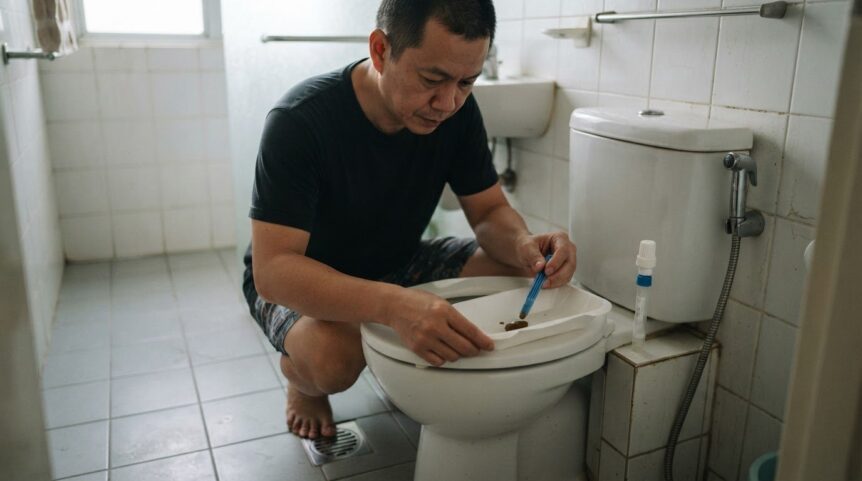
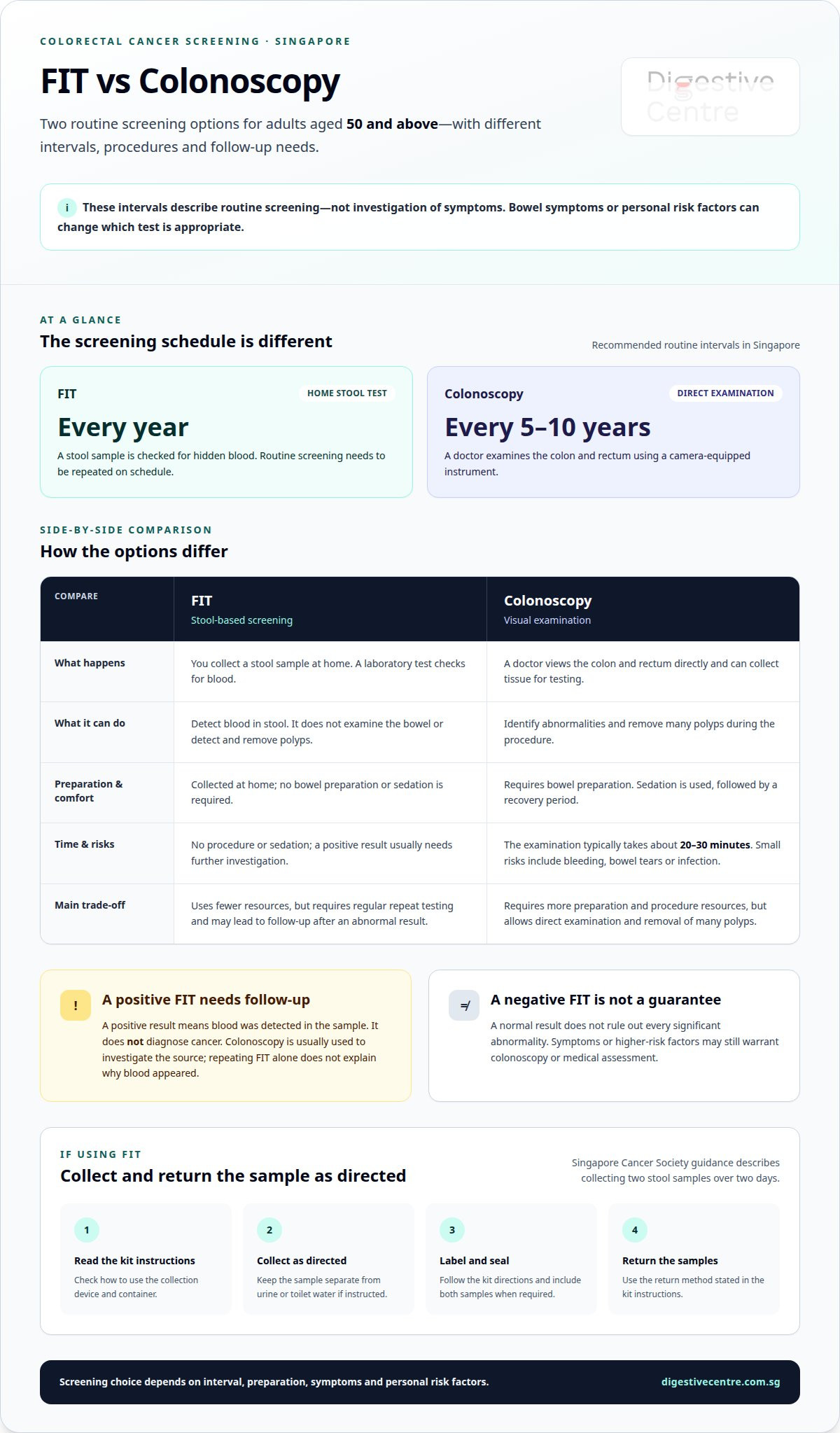
The simpler screening test isn’t always the right fit. In Singapore, for adults aged 50 and above, the colonoscopy vs FIT test decision comes down partly to screening frequency: FIT is recommended once every year, while colonoscopy is recommended once every 5-10 years.
It’s understandable to weigh convenience against a more detailed examination. A FIT test is collected at home, while colonoscopy lets a doctor examine the colon and remove many polyps during the procedure. Neither option is right for every situation.
This guide explains how the tests differ, what to consider when choosing between them, and how to collect a FIT sample. You’ll also learn what a positive FIT result means and why it usually needs follow-up with a colonoscopy. Understanding each step can make it easier to discuss a screening plan suited to your needs.
Key Takeaways
- In Singapore, adults aged 50 and above are recommended to have a FIT once every year or a colonoscopy once every 5-10 years.
- Collect your FIT sample at home and follow the kit instructions for handling and returning it.
- A positive FIT means blood was detected in the stool, not that you have cancer; follow-up colonoscopy is usually needed to investigate.
- A normal FIT doesn’t rule out every significant abnormality, so symptoms and personal risk factors matter when choosing screening.
Should I Do a FIT Test or Colonoscopy for Cancer Screening?
In Singapore, adults aged 50 and above are recommended to have yearly FIT or colonoscopy once every 5-10 years. Colonoscopy has small risks of bleeding, bowel tears, or infection; FIT requires no sedation. Colonoscopy involves preparation and recovery afterward.
When to Begin Screening
In Singapore, men and women aged 50 and above are recommended to begin colorectal cancer screening. Routine options are a fecal immunochemical test (FIT) once every year or colonoscopy once every 5-10 years. These intervals describe screening, not investigation of symptoms. Personal risk factors or bowel symptoms can change which test is appropriate.
Colonoscopy as a Screening Test
Colonoscopy lets a doctor view the entire colon and rectum, identify abnormalities, remove many polyps, and collect tissue for testing. Unlike FIT, which checks a stool sample for blood, colonoscopy allows direct examination and removal during the procedure. In Singapore, it typically takes about 20-30 minutes, followed by recovery from sedation.
Screening Without Bowel Symptoms
Screening looks for colorectal cancer before bowel symptoms appear. FIT is a home-based option that uses a stool sample. Colonoscopy examines the bowel directly and may allow polyps to be removed during the same procedure. A normal FIT does not rule out all significant disease, so symptoms or higher-risk factors may still warrant colonoscopy.
Screening Strategy Cost-Effectiveness
Cost-effectiveness analyses compare strategies such as annual FIT with colonoscopy every 10 years. FIT uses fewer resources but needs regular repetition; colonoscopy requires more resources and can identify and remove many polyps. The comparison includes repeat testing, preparation, procedure resources, and potential follow-up after an abnormal result, not just the initial test.
| Option | Singapore screening frequency | What it involves | Key distinction |
|---|---|---|---|
| FIT | Once every year | Home stool sample | Repeated testing, no sedation |
| Colonoscopy | Once every 5-10 years | Direct examination | Can remove many polyps |
When weighing colonoscopy vs FIT test, consider screening frequency, preparation, symptoms, and risk factors. The choice also depends on whether a direct examination is needed.
FIT sample collection and follow-up testing
A faecal immunochemical test (FIT) checks a stool sample for hidden blood. It is a non-invasive colorectal cancer screening option that you collect at home. Follow the kit instructions carefully to handle the sample correctly. In Singapore, the Singapore Cancer Society describes collecting two stool samples over two days.
- Read the kit instructions before collecting a sample. They explain how to use the collection device and container.
- Collect each sample as directed, keeping it separate from urine or toilet water if the kit instructions require this.
- Label and seal each sample as instructed. Include both samples when the kit requires two collections.
- Return the samples using the method stated in the kit. The American Cancer Society advises generally returning a collected FIT sample within 24 hours, while following kit instructions.
FIT collection does not require bowel preparation or sedation. Unlike colonoscopy, it does not involve examining the inside of the bowel, and it does not detect or remove polyps. FIT may suit routine screening for someone without symptoms, but a negative result cannot rule out every significant abnormality.
After laboratory testing, a positive result means blood was detected in the sample. It does not diagnose cancer. Blood can have different causes, so further investigation is usually needed to identify its source. Colonoscopy is commonly used for follow-up; repeating FIT alone will not explain why blood appeared.
Keep screening on schedule even if a previous FIT result was negative. In Singapore, the recommended routine interval for FIT screening is once every year. Symptoms or changes in risk factors may call for a different approach from routine testing. Follow the kit’s return instructions, and arrange follow-up for a positive result rather than treating FIT as a one-time check.
If follow-up includes an examination, explore colonoscopy care as a next step.
Follow-up colonoscopy after a positive FIT result
A positive faecal immunochemical test (FIT) means blood was detected in the stool sample. It does not mean you have colorectal cancer. Blood can have several causes, including abnormalities that need closer examination. A positive result usually leads to colonoscopy, which allows a doctor to examine the bowel directly and investigate the source of the blood.
Before colonoscopy, bowel preparation clears stool so the doctor can see the colon lining. Preparation may include avoiding solid food the day before. During the procedure, a flexible instrument with a camera passes through the bowel. The doctor examines the colon and rectum, may remove many polyps, and can collect tissue for testing. Sedation is used, followed by a recovery period.
A positive FIT is not proof of cancer, but it should not be ignored. Repeating the stool test does not explain why blood appeared. Further investigation, usually colonoscopy, helps identify the source and assess abnormalities. Changes in bowel habits or rectal bleeding also matter: screening tests are not a substitute for medical assessment when symptoms develop.
FIT can produce false-positive results, meaning blood is detected without colorectal cancer being present. Its false-positive rate is approximately 5%. The American Cancer Society also notes that FIT can miss many polyps and some cancers. A negative result therefore cannot rule out every significant condition, while a positive result needs appropriate follow-up rather than an assumption of cancer.
The examination findings guide what happens next. If the doctor removes a polyp or collects a tissue sample, laboratory testing can help identify it. If no concerning cause is found, follow-up depends on the colonoscopy findings and personal risk factors. Completing the recommended investigation after a positive FIT is an important part of colorectal cancer screening.
Accuracy and limitations of FIT testing
FIT looks for hidden blood in a stool sample, not cancer cells or polyps themselves. Its reported accuracy for ruling out colorectal cancer is 79%, so a normal result cannot exclude every case. A screening test offers useful information, but it does not provide the direct view of the bowel that colonoscopy gives.
Colonoscopy identifies approximately 95% of colorectal cancers. It can also find and remove many polyps during the same procedure, while FIT may miss many polyps and some cancers. A randomised trial found colonoscopy screening detected and removed four times as many advanced adenomas as FIT screening. These figures describe different outcomes, so they should not be treated as a direct, like-for-like comparison.
Accuracy depends partly on what each test is designed to detect. FIT detects blood in a stool sample; an abnormal result signals a need for investigation, not a cancer diagnosis. Colonoscopy lets a doctor examine the colon and rectum directly, but it is a more involved procedure than FIT. Both tests have limitations, so results need to be interpreted in their clinical context.
Some lesions also make detection more challenging. Sessile serrated lesions account for 15%-25% of colorectal cancers, and FIT can miss some cancers and polyps. A normal FIT therefore does not rule out significant disease, especially when symptoms or higher-risk factors are present. New symptoms should be assessed rather than dismissed because a previous screening result was normal.
For routine screening in Singapore, adults aged 50 and above are recommended to have FIT yearly or colonoscopy once every 5-10 years. The right screening option depends on symptoms, risk factors, test limitations, and willingness to complete repeat testing. A doctor can interpret an abnormal FIT or discuss direct examination when clinical findings call for it.
For an assessment of colorectal screening findings, arrange a colonoscopy consultation.
Digestive Centre: Gastroscopy and colonoscopy
Digestive Centre provides colonoscopy for people who need follow-up after a positive FIT or further assessment of bowel symptoms. The procedure lets a doctor examine the colon directly, investigate abnormalities, remove many polyps, and collect tissue samples when needed. It may also be considered when symptoms or personal risk factors make routine stool screening insufficient.
Whether to repeat FIT or have a colonoscopy depends on why screening was done, the result, symptoms, and relevant risk factors. A positive FIT generally calls for further investigation, not a cancer diagnosis. Discussing the result and next steps can clarify whether colonoscopy is appropriate for your situation.
Contact Digestive Centre to discuss colonoscopy and your screening next steps.
Make your next screening decision with confidence
Use what you’ve learned to plan a clear next step. Consider what prompted your screening, any symptoms you’ve noticed, and relevant personal risk factors. Bring previous test results and questions to a discussion with a specialist, so you can focus on what the findings mean for you and what action makes sense.
Choosing between colonoscopy and a FIT test is about more than convenience. Consider how your circumstances affect the screening plan, especially if a result is abnormal or you have symptoms. Digestive Centre provides colonoscopy and can discuss how it fits into your colorectal screening pathway. A discussion can clarify the options without assuming that one test suits everyone.
Contact Digestive Centre to discuss screening and take the next step towards a plan that feels clear and manageable.
Frequently Asked Questions
Colonoscopy vs the Fecal Immunochemical Test: Which is Best?
Neither screening option is best for everyone; the right choice depends on symptoms, risk factors, and what each test can detect. In the colonoscopy vs FIT test decision, consider whether you can complete repeat stool testing or prefer direct examination. FIT is a home-based screening test, while colonoscopy lets a doctor examine the bowel and investigate abnormalities during the procedure.
What Is a Colonoscopy?
A colonoscopy examines the colon and rectum using a flexible instrument with a camera. It allows a doctor to inspect the bowel lining, remove many polyps, and collect tissue for testing. It can be used for screening or to investigate a concern. Before proceeding, discuss your medical history, current medicines, preparation instructions, sedation, and recovery arrangements with your care team.
What Is a FIT Test?
A FIT, or faecal immunochemical test, checks a stool sample for hidden blood. It is a screening test, not a diagnosis: a positive result means blood was detected, while a negative result cannot rule out every abnormality. For example, someone with ongoing bowel symptoms may still need medical assessment despite a normal FIT result.
When Should You Get Screened?
In Singapore, men and women aged 50 and above are recommended to have colorectal cancer screening. For routine screening, the options are yearly FIT or colonoscopy once every 5-10 years. Symptoms or personal risk factors can change the appropriate next step, so don’t treat routine screening intervals as a substitute for assessment of a new bowel concern.
How do I do a FIT?
Use the collection device and follow the instructions supplied with your kit. The Singapore Cancer Society describes collecting two stool samples over two days. Keep each sample handled as directed, then return it according to the kit’s instructions. The American Cancer Society advises generally returning a collected sample within 24 hours. Contact the clinician managing your screening if instructions are unclear.
How do I know if I am eligible for a FIT kit?
The Singapore Cancer Society’s previous kit criteria included no FIT screening in the past 12 months and no colonoscopy in the past 10 years, unless a doctor advised otherwise. The Society stopped distributing FIT kits in 2025. Eligible Singapore citizens enrolled in Healthier SG can receive FIT kits through their enrolled clinic; ask that clinic about the current pathway for you.
The patient guides, service descriptions and other health content on this website are general information… they are not medical advice, they do not create a doctor-patient relationship, and they are not a substitute for a consultation with a doctor who knows your history.
Medical disclaimer. This guide is general health information from Digestive Centre and is not a substitute for a consultation. Symptoms and treatment options differ from person to person. For advice about your own condition, book a consultation with the clinic. In an emergency, call 995.